
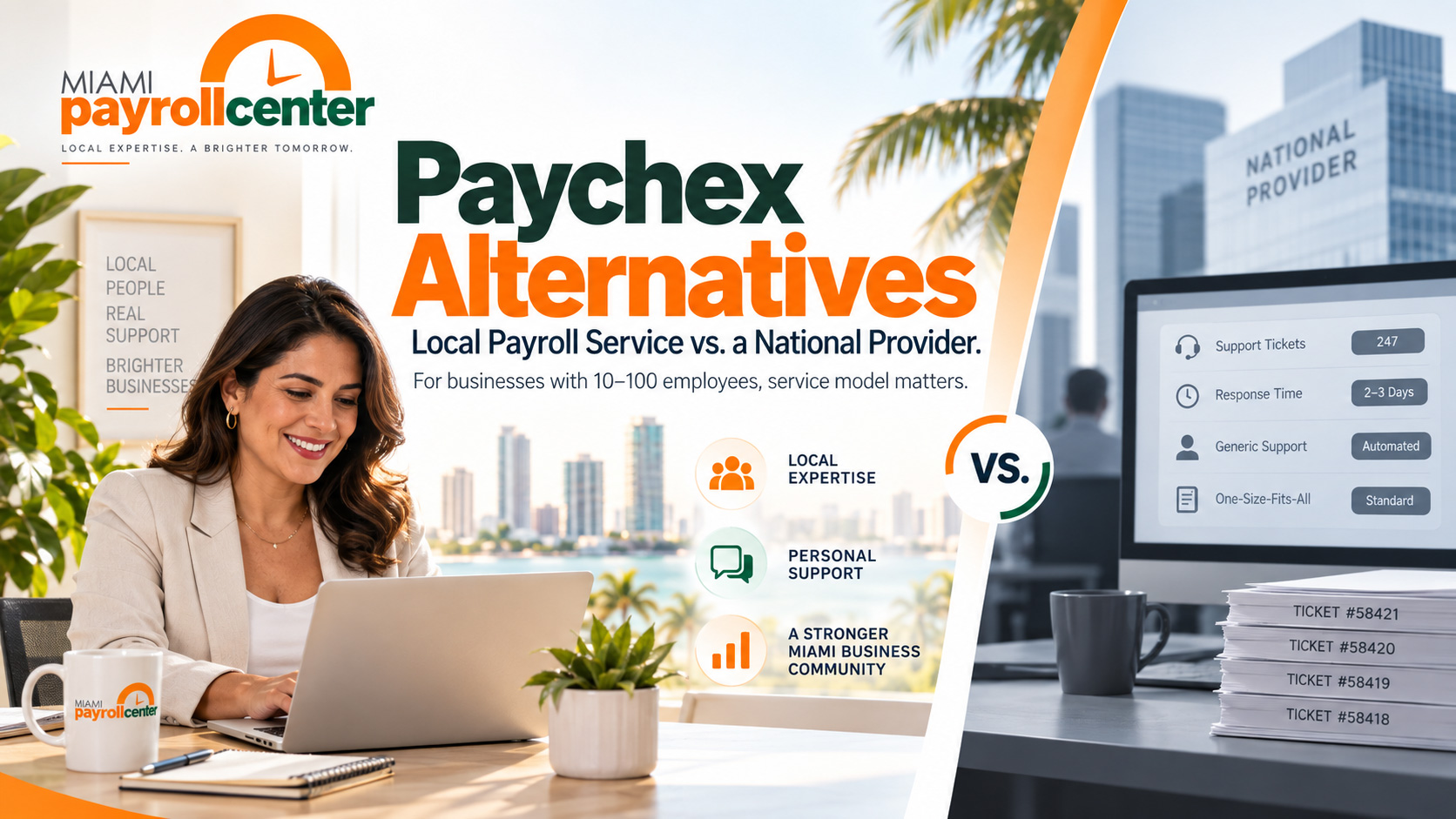
Companies in the 10-to-100 employee range are in an awkward spot in the payroll market. Too big for the cheapest self-service tools, too small to matter much to a national provider’s enterprise team. Paychex serves this band well on paper. Whether it serves you well depends almost entirely on the service model, not the software.
What Paychex is genuinely built for
Paychex is a serious operation with decades of compliance infrastructure behind it. It is a strong fit when:
- You employ people in several states and need registration and filing handled across all of them
- You want payroll, benefits, retirement, and HR consulting purchased from a single vendor
- You need integrated 401(k) administration and want the recordkeeper and payroll provider aligned
- You expect rapid headcount growth and want a platform that will not be outgrown
- Your board, lender, or largest client expects a nationally recognized vendor name
If two or more of those describe you, a switch is probably not worth the disruption. Read the rest of this as a checklist rather than an argument.
Where the model strains at this size
Rep continuity. The single most common complaint we hear from businesses in this range is not about the platform — it is that the person who knows their account keeps changing. Payroll is a relationship business at 40 employees. Institutional memory about your commission structure, your tipped staff, or your seasonal headcount swing has real value, and it does not survive frequent handoffs.
Response time when it matters. Routine questions get answered fine. The problem is the non-routine: a garnishment order with an unusual calculation, a state agency notice, a terminated employee disputing a final check. These need someone who can act today, not a ticket that routes.
Cost creep. Add-on modules accumulate. A business that started at one rate three years ago often finds its effective per-employee cost has climbed 30–40% without a deliberate decision ever being made. Pull your last twelve invoices and calculate your true annual cost per employee before you shop — it is a genuinely useful number and most owners do not know theirs.
Cost comparison at 25 and 50 employees
These are market ranges, not quotes. Get written numbers from every provider you consider.
| Provider type | 25 employees | 50 employees | Pricing structure |
|---|---|---|---|
| National provider (Paychex, ADP) | $3,000 – $5,500 | $6,000 – $11,000 | Base + PEPM, modules billed separately, year-end forms often extra |
| Mid-market platform (Paylocity, Rippling) | $3,600 – $6,000 | $7,200 – $12,000 | Per-module pricing; strong HR, higher entry point |
| SMB platform (Gusto, QuickBooks) | $2,000 – $3,500 | $3,800 – $6,500 | Published pricing, light support |
| Independent local firm | $2,400 – $4,200 | $4,800 – $8,400 | Flat inclusive rate; fewer add-on line items |
| PEO | 2–12% of gross payroll | 2–12% of gross payroll | Percentage-based; rises with every raise |
Notice the last row. A PEO priced at 4% of a $2.5 million payroll costs $100,000 a year — an entirely different order of magnitude, in exchange for a fundamentally different arrangement. If that pitch is on your desk, read PEO vs. payroll service for Florida businesses before you sign.
Tax notice handling: ask this specifically
Here is the question that separates providers more reliably than any feature list: when the IRS or the Florida Department of Revenue sends a notice about my account, what happens?
There are three possible answers.
- “Forward it to us and we’ll handle it, including calling the agency.” This is what you want.
- “Upload it to the portal and our tax team will review it.” Workable, but slow, and you will be chasing status.
- “That’s handled under our compliance add-on.” You are paying extra for something that should be table stakes.
Florida employers deal with fewer agencies than most — no state income tax withholding means fewer touchpoints — but reemployment tax notices, rate protests, and misapplied deposits still happen. Our Florida payroll tax guide covers what those notices typically concern and the deadlines attached to them.
What you give up going local
An honest list, because the trade is real:
- Self-service depth. National platforms have more polished employee apps and more configuration options.
- Integration breadth. Fewer pre-built connectors to niche software.
- Multi-state scale. A local firm can handle two or three states comfortably. Fifteen is a different business.
- Ancillary services under one roof. Retirement recordkeeping, PEO options, and enterprise HR consulting are usually not in scope.
- Redundancy. A national provider has bench depth. Ask any smaller firm directly who covers your account when your contact is out — a good one will answer without hesitating.
A five-point evaluation you can run this week
- Calculate your real cost. Add twelve months of invoices, including January’s. Divide by average headcount. That is your true per-employee cost.
- Count your service touchpoints. How many times in the last year did you need help, and how long did resolution take?
- Check your contract. Term length, auto-renewal date, notice period, early termination clause.
- Get two comparable quotes. Same headcount, same pay frequency, all-in annual, in writing.
- Ask each finalist the notice question above. Then ask for two references at your size in your industry.
If ADP is the other name on your list, the parallel comparison is here: ADP alternatives for small business. The switching mechanics in that article — YTD transfers, quarter-boundary timing, the parallel run — apply identically to a Paychex transition.
Frequently asked questions
What is the best Paychex alternative for a 50-employee company?
For a single-state employer, it is usually either an independent local firm or a mid-market platform. Choose the platform if you need real HR modules; choose the local firm if you mainly need processing done right by someone who knows your account.
Does Paychex charge extra for W-2s?
Year-end form processing is commonly billed separately across national providers. Ask for it in writing — this is one of the largest single line items that fails to appear in an initial quote.
How long does switching take?
Two to three weeks for most businesses in this range. Do not cancel the old account until the first payroll on the new one has run and reconciled.
Will my employees notice?
They will get a new portal login and their direct deposit will come from a different originator. Net pay and deposit timing should be identical. Communicate the change one pay period ahead.
Want a comparable number? Miami Payroll Center has served South Florida employers since 2004 and is SOC 2 Type II audited. Send your headcount and pay frequency and we will return an all-in annual quote you can set next to your current invoice.
Product names and trademarks belong to their respective owners. This article reflects general market positioning as of 2026 and makes no assertion about any provider’s current pricing or contract terms.
Leave a Reply