
A lot of Florida business owners end up in a PEO without ever having compared it to the alternative. The pitch arrives at the right moment — you are frustrated with benefits costs, or an employee issue just cost you a weekend — and the proposal bundles everything into one number. It sounds like simplification. Sometimes it is. Often it is a much bigger commitment than the buyer realizes.
Here is the actual difference, what each costs, and how to tell which one your business needs.
The structural difference: who employs your employees
This is the whole thing, and most comparison articles bury it.
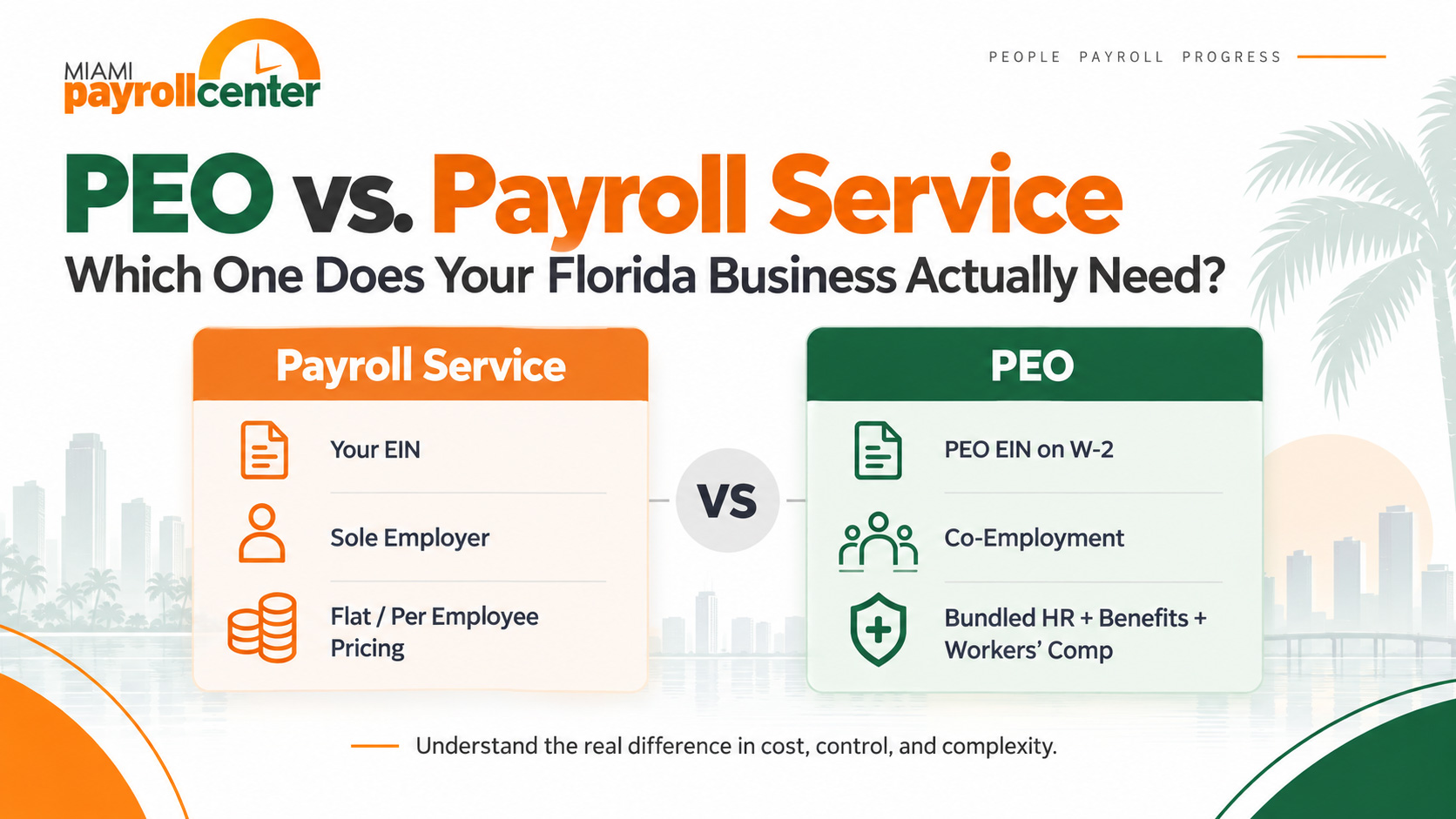
With a payroll service, you remain the sole employer. Wages are reported under your own EIN. Your Florida reemployment tax account, your experience rating, your workers’ compensation policy, your handbook, your liability. The payroll company is a vendor performing a function.
With a PEO, you enter co-employment. Your employees become employees of both your company and the PEO. Wages are typically reported under the PEO’s tax ID. Your staff are covered by the PEO’s benefit plans and its master workers’ compensation policy. You still direct the day-to-day work and decide who to hire and fire, but the employment relationship is legally shared.
In Florida, these arrangements are regulated as employee leasing, and PEOs operating in the state must be licensed by the Department of Business and Professional Regulation. The terms “PEO,” “employee leasing company,” and “staff leasing” are used interchangeably here.
The practical test: Whose EIN appears on your employees’ W-2s? If it is the PEO’s, you are in co-employment. If it is yours, you are using a payroll service — no matter how much HR support comes bundled with it.
Side-by-side
| Payroll service | PEO / employee leasing | |
|---|---|---|
| Employment relationship | You are the sole employer | Co-employment |
| W-2 issued under | Your EIN | PEO’s EIN (typically) |
| Pricing model | Flat fee or per employee per month | Percentage of gross payroll, or bundled PEPM |
| Cost as wages rise | Unchanged | Rises automatically with percentage pricing |
| Health benefits | You source your own plan | Access to the PEO’s larger pooled plans |
| Workers’ compensation | Your own policy and loss history | PEO master policy |
| FL reemployment tax account | Yours; you keep your experience rating | Generally reported under the PEO |
| HR support | Available as a service, advisory in nature | Bundled, typically deeper |
| Employment liability | Yours | Shared, per the contract’s specific terms |
| Exit difficulty | Low — export data and move | High — see the exit section below |
What each one actually costs
The comparison is genuinely difficult because the two are priced on different axes. Work an example.
Take a Miami company with 30 employees and $1.8 million in annual gross payroll.
| Line item | Payroll service + own benefits | PEO at 4% of gross payroll |
|---|---|---|
| Payroll administration | $4,000 – $6,500/yr flat | $72,000/yr bundled admin fee (4% × $1.8M) |
| HR support | $0 – $6,000/yr, if purchased | |
| Benefits administration | Often included with broker | |
| Health insurance premiums | Paid to carrier — market rate | Paid within PEO plan — may be better or worse |
| Workers’ compensation | Your policy, your experience mod | PEO master policy, often loaded above manual rate |
| Administrative cost | ~$4,000 – $12,500/yr | ~$72,000/yr |
That gap is not evidence that PEOs are a rip-off. It is evidence that they are a different product. The PEO number buys pooled benefit purchasing power, bundled workers’ comp, and genuine HR infrastructure. The question is whether you need those things badly enough to justify the difference — and whether the benefits savings actually materialize.
Two things to watch in any PEO proposal:
- Ask whether the percentage applies to gross payroll or to a capped wage base. Some PEOs cap the admin fee at a per-employee wage threshold, which changes the math substantially for higher-paid staff. Get it in writing.
- Ask for the workers’ compensation rate build-up. PEO comp pricing is frequently quoted as a loaded rate that includes admin margin. Compare it against a direct-market quote for the same class codes.
When a PEO is genuinely the right call
There are real scenarios where the answer is yes.
- You cannot get competitive group health on your own. A 12-person company with an older workforce may find PEO pooled rates meaningfully better than the small group market.
- You have high-hazard workers’ comp class codes — roofing, tree work, certain construction trades — and are struggling to place coverage at a workable rate.
- You have no HR function and real exposure. If you are handling terminations, accommodation requests, and harassment complaints on instinct, bundled HR counsel has genuine value.
- You are hiring across many states quickly and do not want to register in each one.
- Leadership bandwidth is the binding constraint. Sometimes paying to make a category of work disappear is the correct business decision.
When a PEO is the expensive answer to the wrong question
- You mainly wanted payroll to run correctly. That is a $5,000 problem, not a $70,000 one.
- You already have a good broker and competitive benefits. The largest single justification for a PEO disappears.
- Your workers’ comp experience mod is good. You may be subsidizing riskier companies inside the PEO’s pool.
- You are planning to raise capital or sell. Diligence on a co-employed workforce adds friction, and buyers routinely ask companies to exit a PEO pre-close.
- Your payroll is growing fast. Percentage pricing means a 20% raise cycle raises your admin fee 20% for no additional service.
Exit friction: the part nobody explains upfront
Entering a PEO takes about three weeks. Leaving takes a quarter, and it is the least discussed part of the decision.
- Reactivate or establish your own accounts. Your Florida reemployment tax account and your own workers’ compensation policy both need to be in place before the transition date.
- Experience rating restarts. If wages were reported under the PEO, your company may have thin standalone reemployment tax history. New employers pay 2.7% on the first $7,000 of each employee’s wages until roughly ten quarters of history accumulate — which may be more than a favorable experience-rated employer would otherwise pay.
- Benefits terminate on exit. Your staff lose PEO plan coverage. You need a replacement plan effective the same day, which means starting the broker conversation 60–90 days out.
- Request your loss runs. You will need them to get sensible workers’ comp pricing. Ask early; they are not always produced quickly.
- Mid-year exits create W-2 complexity. Employees may receive two W-2s for the year. Confirm exactly how this will be handled before you set a date.
- Check the contract. Notice periods and termination windows are often tied to specific dates, not a rolling 30 days.
Before you sign a PEO agreement, read the termination clause first. Not last. It tells you more about the arrangement than the service summary does.
The middle path most Florida businesses overlook
The choice is often presented as “PEO or do it yourself.” It is not. A payroll service with HR advisory and a good benefits broker delivers much of what a PEO delivers, while you keep your EIN, your experience rating, your own workers’ comp policy, and the ability to change vendors without restructuring your employment relationships.
That combination costs a fraction of a percentage-of-payroll arrangement, and it is why many companies that leave a PEO do not go back. It is also the model we built our payroll service and HR support around, with group health and benefits handled alongside rather than bundled inside.
Related reading: if you are also evaluating national payroll providers, see ADP alternatives for small business. For what your obligations look like as a direct Florida employer, see the Florida payroll tax guide for employers. And if your parent company is outside the U.S., this guide to running U.S. payroll from abroad covers the entity and registration sequence.
Frequently asked questions
What is the difference between a PEO and a payroll service?
A payroll service processes payroll under your EIN while you remain the sole employer. A PEO co-employs your staff, reports wages under its own tax ID, and bundles benefits, workers’ comp, and HR for a percentage of gross payroll.
Is employee leasing the same as a PEO in Florida?
Yes — Florida regulates these arrangements as employee leasing, and PEOs operating in the state must be licensed by the Department of Business and Professional Regulation. Verify any PEO’s license before signing.
How much does a PEO cost?
Commonly a percentage of gross payroll, or a bundled per-employee-per-month fee. The percentage model means your cost rises with every raise, regardless of whether the workload changes.
Can I keep my own health insurance plan inside a PEO?
Sometimes, under a carve-out arrangement, but it removes a primary reason to use a PEO. Ask specifically — the answer varies by provider.
What happens to workers’ comp when I leave?
You need your own policy effective the day you exit. Request your loss runs from the PEO early, because limited standalone history can make initial pricing less favorable.
Not sure which side you fall on? Send us your headcount, gross annual payroll, and current PEO admin percentage. We will show you the side-by-side — including the cases where staying put is the better answer.
General information, not legal, tax, or insurance advice. PEO agreements vary substantially; have counsel review any co-employment contract before signing.
Leave a Reply