
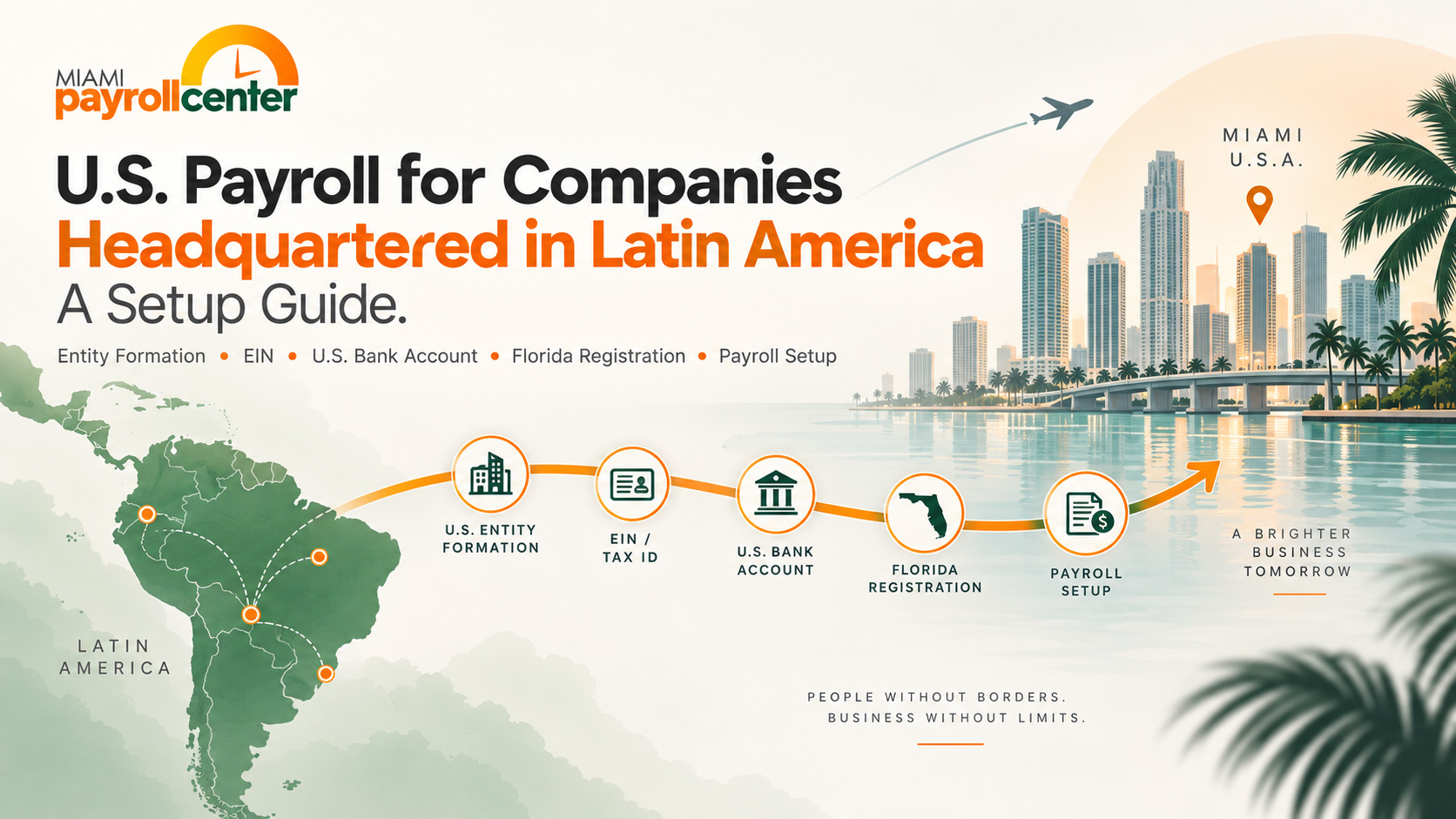
Miami is where most Latin American companies land when they open a U.S. operation, and payroll is usually the step where the timeline slips. Not because it is complicated in itself — Florida is one of the simpler states to employ people in — but because payroll sits at the end of a chain of registrations, and each link takes longer than expected when the owners are outside the country.
This guide lays out the sequence in order, with realistic timing, and flags the three places foreign-owned companies most often get stuck.
First: do you actually need U.S. payroll?
Worth confirming before you spend three months on setup. Three common situations, three different answers.
| Situation | U.S. payroll needed? |
|---|---|
| You are hiring people who live and work in the United States | Yes. Work performed in the U.S. is generally subject to U.S. payroll tax and reporting. |
| Your team is in Bogotá, São Paulo, or Mexico City, serving U.S. clients | No. They are paid under local law in their own country. |
| You have one U.S.-based salesperson and want to pay them as a contractor | Probably yes, as an employee. See the classification section — this is the single most common and most expensive mistake. |
Step 1 — Form a U.S. entity
You need a legal entity before you can employ anyone. Two structures dominate for foreign-owned operations.
C corporation. The default for companies expecting outside investment or a parent-subsidiary structure. Clean, familiar to U.S. banks and investors, and the standard choice when the parent wants a defined subsidiary. Florida taxes C corporations at 5.5% on Florida-source income, subject to an exemption threshold.
LLC. Simpler and cheaper to maintain, but tax treatment for a foreign owner requires care — a single-member LLC owned by a foreign person has federal filing obligations that surprise people, including Form 5472 requirements. Do not choose between these based on a blog post. This is the one step where paying a U.S. tax advisor with cross-border experience pays for itself.
Either way you will need a registered agent with a physical Florida street address. A mailbox service does not qualify.
Realistic timing: 1–2 weeks once documents are ready.
Step 2 — Get an EIN (this is the bottleneck)
The Employer Identification Number is your federal tax ID. Nothing downstream — bank account, payroll registration, tax deposits — happens without it.
Here is the part that catches foreign owners: the IRS online EIN application generally requires the responsible party to have a U.S. taxpayer identification number (SSN or ITIN). If your responsible party is a foreign individual without one, you cannot use the online system. You file Form SS-4 by fax or mail instead, and processing takes considerably longer — commonly several weeks by fax and longer by mail.
Start the EIN application before you think you need it. This single step is responsible for more delayed U.S. launches than everything else on this list combined. If your first hire has a start date, work backwards from it by at least eight weeks.
Realistic timing: same day if online is available; several weeks to a few months otherwise.
Step 3 — Open a U.S. bank account that can originate ACH
Payroll direct deposit runs on ACH, which means you need a real U.S. business operating account — not just a payment platform. Banks apply beneficial ownership rules to foreign-owned entities, and most will want formation documents, the EIN letter, passports and proof of address for beneficial owners, and often an in-person visit by a signer.
Two practical notes. First, fund the account with a working balance well ahead of your first payroll; tax deposits and net pay both draft from it, and a failed draft on payroll day is not a small problem. Second, account for FX timing — moving funds from a parent company abroad is not instantaneous, and payroll deadlines do not move.
Realistic timing: 2–6 weeks, longer if a signer must travel.
Step 4 — Register with Florida
Florida is genuinely lighter than most states here. There is no state income tax, so there is no state withholding to register for or administer. What you do need:
- Florida reemployment tax account with the Department of Revenue. This is Florida’s unemployment insurance tax. Register before your first payroll. New employers pay 2.7% on the first $7,000 of each employee’s wages per year — a maximum of $189 per employee — for roughly the first ten quarters, after which you are assigned an experience-rated figure.
- Workers’ compensation coverage. Requirements depend on industry and headcount; construction thresholds are stricter than most. Confirm your obligation before the first hire, not after.
- Florida new hire reporting for each new employee, within the required window after hire.
The complete rate, form, and deadline picture is in our Florida payroll tax guide for employers.
Step 5 — Classify your workers correctly
This is where foreign-owned companies take on the most risk, usually with good intentions. Paying a U.S.-based worker as an independent contractor looks like a clean way to start before the entity is ready. If that person works set hours, uses your systems, reports to your managers, and works only for you, they are very likely an employee under U.S. rules — regardless of what the agreement says or what is normal in your home market.
Misclassification exposure includes back employment taxes, penalties, interest, and potential wage-and-hour claims. It is one of the most commonly enforced issues in U.S. employment.
Also expect a genuine culture gap: U.S. employment is at-will in Florida, with no statutory severance, no mandated 13th-month payment, and no state-required paid leave — but overtime rules under the Fair Labor Standards Act are strict and unfamiliar to many managers arriving from Latin America. Exempt status depends on both a salary threshold and the actual duties performed. A job title alone does not make anyone exempt.
Step 6 — Work authorization and I-9
Every employee, U.S. citizen or not, completes Form I-9 within the required timeframe after hire. Florida additionally requires private employers with 25 or more employees to use E-Verify for new hires. If your U.S. headcount will cross that threshold, build the process in from day one rather than retrofitting it.
If you plan to transfer staff from the parent company rather than hire locally, that is an immigration question with its own timeline — intracompany transfer and treaty investor categories exist, but eligibility varies by country and circumstance. Engage U.S. immigration counsel early; it runs on a separate and usually longer clock than everything else here.
Realistic timeline
| Step | Typical duration | Can run in parallel with |
|---|---|---|
| Entity formation + registered agent | 1–2 weeks | — |
| EIN (Form SS-4, non-U.S. responsible party) | Several weeks or more | Bank pre-application, payroll provider selection |
| U.S. bank account | 2–6 weeks | Florida registrations |
| Florida reemployment tax registration | 1–2 weeks | Workers’ comp placement |
| Payroll setup and test run | 1–2 weeks | Offer letters, onboarding |
| Total, realistic | 8–16 weeks |
Choosing a U.S. payroll partner
For a foreign parent company, three things matter more than software features.
Security posture you can document. Your finance team will be sending employee data across borders. A SOC 1 audit is the standard evidence that a provider’s controls have been independently tested over time, not just described. Ask for the report — Miami Payroll Center is SOC 1 audited and provides it on request.
Someone who answers in your time zone and understands the context. Cross-border payroll questions do not fit well into a ticket queue.
Experience with foreign-owned entities specifically. The failure modes — EIN delays, funding timing, beneficial ownership documentation, first-quarter filings for a mid-quarter start — are predictable if the provider has seen them before.
Related: if a PEO or employee leasing arrangement has been proposed as a shortcut, understand what it changes about the employment relationship first — see PEO vs. payroll service. And for a comparison of the major U.S. payroll providers, see ADP alternatives for small business.
Opening a U.S. operation? Miami Payroll Center has supported South Florida employers since 2004, including companies whose parent organizations are headquartered in Central and South America. We can map your sequence and timeline before you commit to a start date.
Talk to us about U.S. setup · Payroll services · Payroll tax filing
General information for planning purposes, not legal, tax, or immigration advice. Entity selection, worker classification, and immigration matters should be reviewed by qualified U.S. professionals before you act.
Leave a Reply